
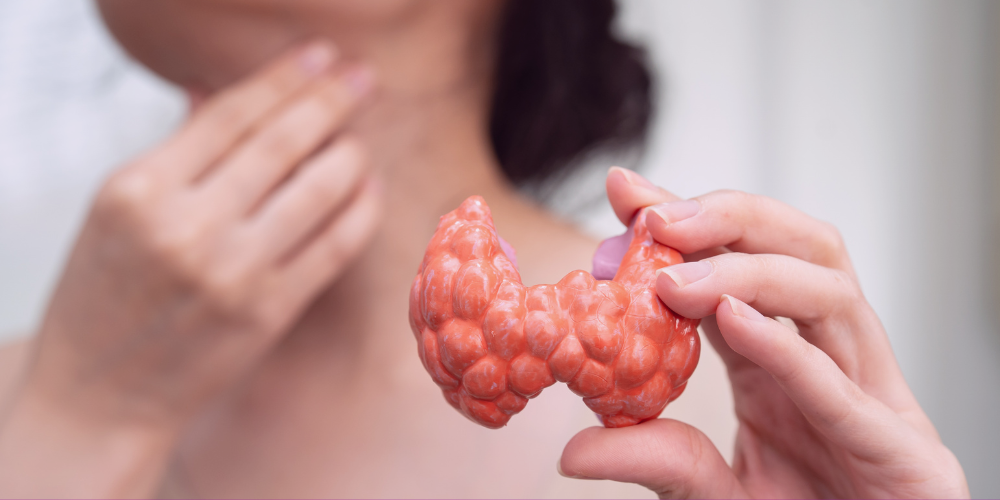
A single normal TSH does not rule out a thyroid problem, especially during perimenopause. Free T4, free T3, and TPO antibodies each catch patterns TSH alone can miss, and fluctuating estrogen can change how thyroid hormone shows up on standard bloodwork even when the thyroid gland itself hasn't changed.
Women in their 40s bring me a familiar list more often than almost anything else. Fatigue that sleep doesn't touch. Hair coming out in the shower. Feeling cold when nobody else in the room is. A period that used to be predictable and now isn't. Many have already had their thyroid checked. It came back normal.
They're not wrong to have asked. The test just doesn't capture everything they're describing.
Why TSH Alone Isn't the Whole Picture
Most thyroid screening starts and stops with a single test, thyroid stimulating hormone, or TSH. It's a reasonable first step, and for a lot of people it's enough. But TSH is a pituitary signal, not a direct measurement of how much thyroid hormone your tissues are using. It reflects how hard your pituitary gland thinks it needs to push your thyroid to keep up, which is a related question and not the same one.
Clinical guidance on thyroid testing is explicit about this limitation. A widely cited Endotext chapter on thyroid function testing notes that a "TSH alone" approach "has important drawbacks and limitations," including that TSH can be suppressed by certain medications without reflecting true thyroid status, and that it loses diagnostic value entirely when pituitary function itself is abnormal (Endotext, NCBI Bookshelf). The same source points out that hormone-binding proteins shift during states like pregnancy in ways that change how free thyroid hormone should be interpreted, a detail that matters more than most standard panels account for.
What Free T4, Free T3, and TPO Antibodies Add
Free T4 and free T3 measure the thyroid hormone actually circulating and available to your tissues, with free T3 representing the form your cells use directly. Reading TSH alongside free T4 and free T3, rather than TSH in isolation, gives a fuller picture of what your thyroid is actually doing.
Thyroid antibodies add a different kind of information. Thyroid peroxidase, or TPO, antibodies indicate an autoimmune process targeting the thyroid gland, the kind seen in Hashimoto's thyroiditis. Research on TPO antibodies has examined them specifically as an early marker, since they can be present years before TSH moves outside of a standard reference range at all (Autoimmune Diseases, Siriwardhane et al.). A person can have autoimmune thyroid disease actively underway while their TSH still looks unremarkable on paper.
The Perimenopause Complication: Estrogen and Thyroid Binding Globulin
Perimenopause adds a layer most standard panels don't account for. Thyroid hormone doesn't travel through your bloodstream on its own. Most of it rides on a carrier protein called thyroid binding globulin, or TBG, and only the unbound, "free" portion is available for your tissues to use.
Estrogen increases how much TBG your liver produces. This is well documented in women starting estrogen therapy: a classic study in the New England Journal of Medicine found that hypothyroid women often need a higher dose of thyroid hormone medication once they start estrogen, because more of their thyroid hormone ends up bound to TBG instead of freely circulating (NEJM, Arafah). Perimenopause isn't estrogen therapy, but it is a period of significant, often erratic estrogen fluctuation, and the same binding-protein mechanism can shift how thyroid hormone shows up on a standard panel even when your thyroid gland hasn't changed at all.
The takeaway: the same TSH that looked fine in your 30s can be telling a different story in your 40s, on a body that's also managing an entirely separate hormone transition.
Where Thyroid and Perimenopause Symptoms Overlap
None of this happens in a vacuum. A position statement from the European Menopause and Andropause Society on thyroid disease and menopause names the overlap directly: both conditions can present with menstrual irregularities, mood changes, sleep disturbance, hair loss, and reduced quality of life, and the statement specifically recommends that menopause be included in the differential diagnosis of both hypothyroidism and hyperthyroidism, and vice versa (Maturitas, EMAS Position Statement).
That overlap runs in both directions. A thyroid problem can look like perimenopause. Perimenopause can look like a thyroid problem. Sorting out which one you're dealing with, or whether it's some of both, usually requires looking at both pictures together rather than ruling one out based on a single test.
What a Fuller Thyroid Workup Actually Looks At
A more complete look at thyroid function typically includes:
- TSH, as a starting point, not the final word
- Free T4 and free T3, to see what's actually circulating and available
- TPO antibodies, to check for an autoimmune process TSH alone won't flag
- Context, including where you are in your cycle or hormone transition, and any medications or supplements that affect binding proteins or lab accuracy
None of this means every case of fatigue or brain fog in your 40s traces back to your thyroid. It means one normal TSH, checked once, isn't the same as ruling your thyroid out.
When This Is Worth Investigating
If any of the following sound familiar, a fuller thyroid picture is worth pursuing rather than assuming it's already been ruled out:
- Your thyroid has been checked and called normal, but the fatigue, cold sensitivity, or hair thinning hasn't budged
- Your cycle has become heavier, lighter, or less predictable alongside these symptoms
- You have a family history of thyroid disease, especially autoimmune thyroid conditions
- You started or changed hormone therapy and haven't had your thyroid rechecked since
Getting Started
- Ask for a fuller panel, not just TSH: free T4, free T3, and TPO antibodies together.
- Note your hormone context when you're tested, including where you are in perimenopause or whether you're on hormone therapy, so results can be read in that light.
- Track symptoms over time, not just at the moment of a single blood draw, since both thyroid and perimenopause symptoms can fluctuate.
- Bring prior labs to whoever evaluates you next, so nothing has to be repeated unnecessarily.
If you want a starting point before booking anything, Why Am I So Tired Assessment can help connect your symptoms to what's likely driving them.
A normal TSH is a data point, not a verdict. A fuller picture is usually worth the extra two tests.
Frequently Asked Questions
Does a normal TSH mean my thyroid is fine?
Not necessarily. TSH is a useful first test, but it's a pituitary signal, not a direct measurement of thyroid hormone your tissues are using. Free T4, free T3, and TPO antibodies can each surface patterns a normal TSH misses.
What's the difference between TSH and free T4 or free T3?
TSH reflects how hard your pituitary gland is signaling your thyroid to work. Free T4 and free T3 measure the actual thyroid hormone circulating and available to your cells, with free T3 being the form your tissues use directly.
What are TPO antibodies and why do they matter?
Thyroid peroxidase (TPO) antibodies indicate an autoimmune process targeting the thyroid, as seen in Hashimoto's thyroiditis. They can be present years before TSH moves outside a standard range.
Can perimenopause actually affect thyroid lab results?
Fluctuating estrogen can change how much thyroid binding globulin your body produces, which affects how thyroid hormone shows up on standard bloodwork, even when your thyroid itself hasn't changed. This is well documented in women on estrogen therapy, and the same binding-protein mechanism is relevant during perimenopause's estrogen swings.
If my thyroid is normal, could perimenopause explain all my symptoms instead?
Possibly, and that's worth exploring too. But because thyroid and perimenopause symptoms overlap so closely, clinical guidance recommends considering both rather than assuming one explanation rules out the other.
What should I ask for if I want a fuller thyroid picture?
Ask for free T4, free T3, and TPO antibodies alongside TSH, and mention your hormone context, including where you are in perimenopause or whether you're on hormone therapy, so the results can be read accordingly.

Dr. Erin Ellis, ND
Dr. Erin Ellis, ND, is the founder of Hope Natural Health and a licensed Naturopathic Doctor with more than nine years of clinical experience specializing in women's hormone health. After overcoming cancer, Dr. Ellis made it her life's mission to help women find the root cause of why they don't feel like themselves. She believes "normal" lab results are only the beginning of the conversation - not the end - and is known for taking a deeper, investigative approach to hormone, thyroid, gut, and metabolic health.